|
Detailed Design Specification:
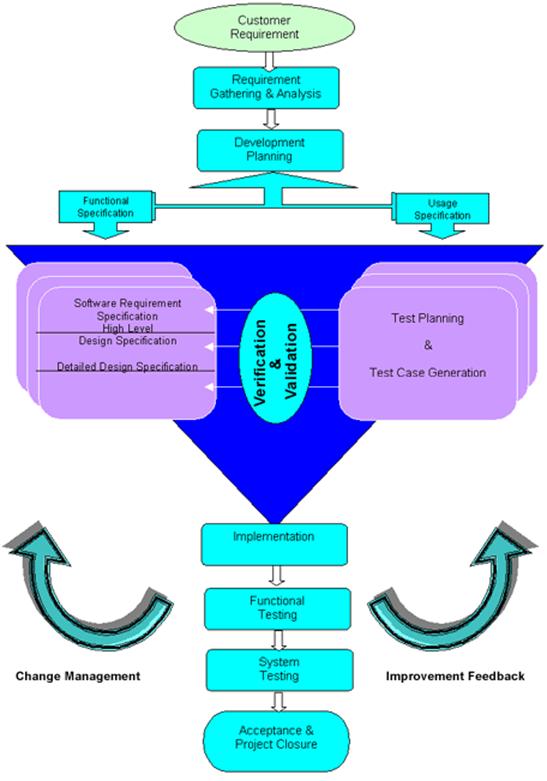
Detailed Design is the process of transforming the HLD into a more detailed level from the perspective of a part (Modules, macros, includes, and so forth). Its objectives are as follows:
• Finalize the design of components and parts within a system or product.
• Complete the Component (Unit) Test Plans.
• Feedback to HLD, Verify changes in HLD.
The Detailed Design description process is also grouped into three Phases: preparing the DDS, reviewing the same and obtaining the final sign-off from the Project Manager or customer. After the sign-off, the Functional baseline for requirements is established.
Link to Top
Implementation:
This phase largely focuses on three stages: Coding (Build), Unit Testing and Integration Testing.
Coding Stage: The coding portion of the process results in the transformation of the DDS for a function to completely coded parts. The objectives of this stage are as follows:
• Code Parts (modules, macros, includes, messages and so forth)
• Code Unit Test Cases
• Verify changes in HLD or DDS.
Unit Testing: This is the first test performed on an executable module. Its objectives are as follows:
• Verify the code against the component's of DDS
• Execute all new and changed code to ensure that all the branches are executed in all directions
• Correctness of the logic, and data path are verified
• Exercise all error messages, return codes and response options.
• Feedback to code, LLD and HLD
The level of Unit Testing is for verification of limits, internal interfaces, and logic and data paths in a module, macro or executable include. Unit Test is performed on non-integrated code and may require scaffold code to construct the proper environment
Integration Testing: Integration Test is the testing of the combined software parts that make up a component after the software parts have been integrated into the system library. Integration Testing is a systematic technique for constructing the program structure while at the same time conducting tests to uncover errors associated with interfacing. The objectives of this test are as follows:
• Test External User Interfaces to the component's design documentation - User Requirement.
• Test component interfaces to the components design documentation.
• Test application program interfaces to the component's design documentation.
• Test error recovery and messages to the component's design documentation.
• Test the shared paths (Multitasking) and shared resources (Files, locks, queues, etc.) to the component's design documentation.
Link to Top
|